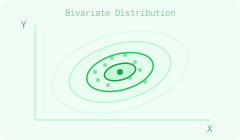
Joint Distributions & Random Vectors
Intermediate·
~2h 30min
·0 / 2 solved
Joint, marginal, and conditional distributions; covariance, correlation, and independence of random vectors.
Prereqs:Continuous Distributions
Joint, marginal, and conditional distributions; covariance, correlation, and independence of random vectors.
This topic extends probability to multiple random variables. We cover joint and marginal densities, conditional distributions, independence, and operations on pairs of random variables. We then generalize to random vectors, introducing the covariance matrix, and give full treatment to Gaussian vectors — the most important multivariate distribution in probability and finance.
A pair of continuous random variables has a joint density such that for any Borel set :
satisfying and .
The marginal densities of and are obtained by integrating out the other variable:
Knowing the marginals and is not sufficient to recover the joint density — you also need the dependence structure. The joint density contains strictly more information than the two marginals separately, unless and are independent.
The conditional density of given (with ) is:
The conditional density is the continuous analog of Bayes: . This is the foundation of Bayesian inference for continuous parameters.
and are independent if and only if their joint density factors:
The converse is false in general. The canonical counterexample: , — then but is completely determined by .
The covariance between and measures linear dependence:
If and are independent continuous random variables, the density of is:
In practice, use MGFs to find the distribution of a sum: when , then identify the resulting MGF. Convolution integrals are a last resort.
If and are independent with densities and , the density of is:
If , then has density for .
If and are independent with densities and and , the density of is:
If independent, then .
The ratio of two independent standard normals is Cauchy — this is why the Cauchy has no mean (its tails are too heavy). More generally: is a ratio distribution.
A random vector is a measurable function from to . Its distribution is characterized by the satisfying:
The covariance matrix of is the matrix:
The covariance matrix is the fundamental object in portfolio optimization (Markowitz), PCA, and multivariate regression. In interviews, know that is the variance of the portfolio .
Let have joint density and where is a diffeomorphism. Then:
Polar coordinates: with , . The Jacobian gives , so .
A random vector is a (multivariate normal) if every linear combination follows a normal distribution. We write .
The definition via linear combinations is more general than the density formula — it covers degenerate cases where is only positive semi-definite (e.g. ). A vector with all is Gaussian — the components must be jointly Gaussian.
Partition with and . Then:
The conditional mean is linear in — this is the multivariate version of linear regression. The conditional variance (Schur complement) does not depend on .
Let be a Gaussian vector. Then:
This result is specific to Gaussian vectors. For general random variables, uncorrelated does not imply independent — the Gaussian structure is essential. In interviews, always verify that is jointly Gaussian before concluding independence from zero covariance.
| Concept | Formula |
|---|---|
| Joint density normalization | |
| Marginal of |
| Statement | True or False |
|---|---|
| Marginals determine joint distribution | ❌ False in general |
| ✅ Always | |
Equivalently: .
The correlation coefficient:
The marginal density of is obtained by integrating out all other components.
with entries and .
where is the Jacobian matrix of .
When is positive definite, the joint density is:
| Conditional density |
| Independence |
| Covariance |
| Correlation |
| Convolution () |
| Product density () |
| Covariance matrix |
| Variance of linear combination |
| Linear transform of vector |
| Gaussian vector density |
| Gaussian conditional mean |
| Gaussian conditional variance |
| ❌ False in general |
| + Gaussian vector | ✅ True |
| for all Gaussian vector | ❌ False in general |
| Linear transform of Gaussian vector is Gaussian | ✅ Always |