Discrete Distributions
Beginner·
~2h
·0 / 8 solved
Bernoulli, Binomial, Geometric, Poisson — their properties and common applications.
Prereqs:Random Variables
Bernoulli, Binomial, Geometric, Poisson — their properties and common applications.
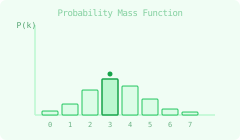
Discrete distributions model random variables that take countable values. This topic covers the foundational tools (PMF, CDF) and the full catalog of classical discrete distributions organized by family — Bernoulli, waiting time, counting, and uniform. Each distribution is presented with its key formulas, MGF, and typical interview use cases.
A random variable is discrete if it takes values in a countable set . Its distribution is characterized by its probability mass function (PMF):
satisfying for all and .
The CDF of a discrete random variable is:
For discrete RVs, is a right-continuous step function with jumps of size at each value . In particular .
The tail formula is the fastest way to compute for geometric and negative binomial distributions — avoid expanding the series directly.
A Bernoulli random variable models a single trial with success probability :
A Binomial random variable counts the number of successes in independent Bernoulli trials:
. The binomial is the sum of i.i.d. Bernoulli variables — this is the key structural fact used in most proofs.
Use Binomial when: fixed number of trials , each trial independent, same success probability . When is large and small with fixed, approximate with Poisson.
The Multinomial distribution generalizes the Binomial to possible outcomes. If independent trials each result in outcome with probability (with ), the joint PMF of is:
The negative covariance makes sense: if category gets more counts, category must get fewer (the total is fixed at ).
A Geometric random variable counts the number of trials until the first success in independent Bernoulli trials:
The memoryless property is unique to the geometric distribution among discrete distributions (and to the exponential among continuous). It states that past failures give no information about future trials.
Use Geometric for: "number of trials until first success", "number of coin flips until first head", coupon collector sub-problems. The memoryless property is the key to many elegant solutions.
A Negative Binomial random variable counts the number of trials until the -th success:
Use Negative Binomial when: waiting for the -th success, modeling overdispersed count data (variance mean). The decomposition as a sum of geometrics makes moment calculations immediate.
A Poisson random variable counts the number of events occurring in a fixed interval, with average rate :
The Poisson distribution has the unique property that mean = variance = . In practice: if you observe count data with mean variance, Poisson is the natural model. If variance mean (overdispersion), use Negative Binomial.
Use Poisson for: number of rare events in a large population ( large, small, ), arrivals in a time window, number of defaults in a portfolio. The stability under addition () is the key property.
A Hypergeometric random variable counts the number of successes when drawing items without replacement from a population of items containing successes:
The factor is the finite population correction — it accounts for the dependence between draws. When , draws are nearly independent and Hypergeometric Binomial.
Use Hypergeometric whenever sampling is without replacement from a finite population — card games, quality control, drawing from an urn without replacement.
A Discrete Uniform random variable assigns equal probability to each value in :
| Distribution | Parameters |
|---|
| Relationship | Statement |
|---|---|
| Bernoulli → Binomial | Sum of i.i.d. Bernoulli Bin |
| Geometric → Neg. Binomial | Sum of i.i.d. Geom NB |
where , .
| Typical use |
|---|
| Bernoulli | , | Single trial | ||||
| Binomial | , | |||||
| Geometric | ||||||
| Neg. Binom | , | |||||
| Poisson | ||||||
| Hypergeometric | ||||||
| Uniform |
| Binomial → Poisson | Bin Poisson as |
| Hypergeometric → Binomial | Hyper Bin as |
| Poisson stability | Poisson + Poisson = Poisson |
| Binomial stability | Bin + Bin = Bin |
| independent trials |
| Wait for 1st success |
| Wait for -th success |
| Rare events, counts |
| — |
| Sampling w/o replacement |
| Equally likely outcomes |