Continuous Distributions
Beginner·
~2h
·0 / 10 solved
Uniform, Exponential, Normal, Gamma — densities, moments, and key identities.
Prereqs:Random Variables
Uniform, Exponential, Normal, Gamma — densities, moments, and key identities.
Continuous distributions model random variables that take values in an uncountable set, characterized by a density function rather than a PMF. This topic covers the foundational tools (density, CDF, change of variable) and the full catalog of classical continuous distributions organized by family — uniform/exponential, normal, gamma, and heavy-tailed. Each distribution is presented with its key formulas, MGF, and typical interview use cases.
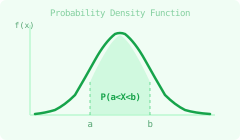
A random variable is continuous if there exists a non-negative function , called the probability density function (PDF), such that for all :
For any measurable function :
The tail formula avoids direct integration when has a clean closed form — particularly useful for Exponential and other distributions where the survival function is simpler than the density.
Let be a continuous RV with density and where is and differentiable. Then has density:
Let have joint density and where is a diffeomorphism. Then:
For the non-monotone case (e.g. ), split the domain into monotone pieces and sum the contributions: where are the preimages of .
Let and . Then and , so:
is uniformly distributed on if it is equally likely to take any value in the interval:
The uniform distribution is the foundation of simulation: if then for any distribution with invertible CDF (inverse transform method).
The Exponential distribution models the waiting time between events in a Poisson process:
The memoryless property means past waiting time gives no information about future waiting time. It is the continuous analog of the Geometric distribution's memoryless property.
Use Exponential for: inter-arrival times in a Poisson process, time to failure, service times. If are i.i.d. Exp, then — a very useful result for competition/race problems.
follows a Normal (Gaussian) distribution with mean and variance :
For : , , — the .
Key results to know instantly: for (from MGF at ). This is the foundation of the Black-Scholes formula.
is Log-Normal with parameters and if :
The Log-Normal has no MGF for — a classic interview trap. Use the moment formula directly instead.
Log-Normal is the standard model for asset prices in finance: if log-returns are normal (Black-Scholes assumption), prices are log-normal. is the expected stock price under this model.
The Gamma distribution generalizes the Exponential to the sum of exponential waiting times. With shape and rate :
Sum of i.i.d. Exp variables — use this to find the distribution of total waiting time for events in a Poisson process.
The Chi-Squared distribution with degrees of freedom is the distribution of the sum of squares of independent standard normal variables:
appears whenever you sum squared normals — sample variance, goodness-of-fit tests, confidence intervals for variance. For large : by CLT.
The Beta distribution models a random variable on , with shape parameters :
Use Beta for modeling probabilities or proportions (values in ). It is the conjugate prior for the Binomial in Bayesian inference — a key result in quantitative interviews involving Bayesian updating.
The Student- distribution with degrees of freedom arises as the ratio of a standard normal to the square root of a scaled chi-squared:
Student- is used in statistics when the population variance is unknown. In interviews: with small has heavy tails — important for modeling financial returns where extreme events are more frequent than the Normal predicts.
The Fisher F-distribution with degrees of freedom is the ratio of two independent scaled chi-squared variables:
The F-distribution appears in ANOVA and regression — testing whether multiple group means are equal, or whether a set of regression coefficients are jointly zero. Know it structurally: ratio of two chi-squared divided by their degrees of freedom.
The Cauchy distribution with location and scale :
The Cauchy distribution is the canonical example of a distribution with undefined mean and variance. The sample mean of i.i.d. Cauchy variables does not converge — the Law of Large Numbers fails. This is a classic interview trap: "does the LLN apply?" → check whether .
| Distribution | Parameters |
|---|
| Relationship | Statement |
|---|---|
| Exp → Gamma | Sum of i.i.d. Exp |
| Normal → Chi-Squared | , |
where is the Jacobian matrix of .
This is the Log-Normal density.
The Exponential is the unique continuous memoryless distribution.
The standard normal has density and CDF .
where is the Gamma function, satisfying for .
where is the Beta function.
| Typical use |
|---|
| Uniform | on | Equal likelihood, simulation | ||||
| Exponential | , | |||||
| Normal | , | |||||
| Log-Normal | , | |||||
| Gamma | ||||||
| Chi-Squared | density | |||||
| Beta | on | |||||
| Student- | see above | () | () | |||
| Fisher | ||||||
| Cauchy | , |
| Chi-Squared → Gamma |
| Normal → Log-Normal |
| Normal + Chi-Squared → Student |
| Chi-Squared + Chi-Squared → Fisher |
| Student → Cauchy |
| Beta → Uniform |
| Normal |
| Waiting times, memoryless |
| CLT limit, returns |
| — |
| Asset prices |
| Sum of exponentials |
| Sum of squared normals |
| — |
| Probabilities, Bayesian prior |
| — |
| Unknown variance, heavy tails |
| — |
| — |
| — |
| ANOVA, regression tests |
| undefined |
| undefined |
| — |
| Heavy tails, LLN failure |